
Education
Why does knee pain happen? Common causes and sensible next steps
Understand why knees hurt, which symptoms need assessment, what care is usually recommended, and where stem cell therapy fits into the discussion.
Educational content, not individual medical advice.
At a glance
Knee pain is a symptom, not a diagnosis. It may come from the joint, a tendon, an injury, inflammation, or another part of the body. Understanding the pattern helps your medical team recommend appropriate care before any injection or other procedure is considered.
Several structures can cause knee pain
Your knee is more than the space between two bones. Cartilage covers the joint surfaces, the menisci help distribute load, ligaments steady the joint, and muscles and tendons move it. The kneecap also moves against the thigh bone. Irritation or injury in any of these structures can produce symptoms that feel similar at first.
The location of pain gives clues, but it cannot confirm the cause by itself. Pain at the front may involve the kneecap or its tendon, while pain along the joint line may involve the meniscus or osteoarthritis. A painful knee can also reflect a problem in the hip or back. An examination puts these possibilities into context.
Osteoarthritis affects the whole joint
Osteoarthritis involves changes in cartilage, bone, and the tissues around the joint. It is not simply a matter of a knee being worn out. Previous injury, age, body weight, and other factors can contribute. People often describe discomfort with activity and stiffness after sitting, although the pattern varies and symptoms can fluctuate.
A scan does not measure how much pain someone should feel. Visible changes can occur with few symptoms, and significant discomfort can occur without severe imaging changes. Your medical team should consider walking, sleep, daily tasks, and examination findings alongside any scan. Decisions should not be based only on a phrase such as cartilage thinning in a report.
Injury and sudden changes in activity
A twist, fall, or impact may injure a ligament or meniscus. Swelling, difficulty bearing weight, or a knee that feels unstable after an injury deserves assessment. Some meniscal changes also develop gradually without one obvious accident. Clicking alone does not establish a tear, but a knee that truly becomes stuck needs medical attention.
Symptoms can also appear after a sudden increase in running, stairs, kneeling, or lifting. Tendons and the tissues around the kneecap may be sensitive when activity exceeds what they are accustomed to. This does not mean all movement is harmful. The useful question is which activities need temporary adjustment and how to rebuild tolerance safely.
Inflammation and other causes need different care
Not every swollen knee is osteoarthritis. Gout, inflammatory arthritis, an irritated bursa, and infection are among the other possibilities. A hot, red joint that becomes painful quickly should not be assumed to be an ordinary flare, particularly if you have fever or feel unwell. These situations may need urgent investigation rather than an exercise programme.
Tell the medical team about other painful joints, prolonged stiffness, skin changes, recent illness, and medicines that affect immunity. These details can change the assessment. Treating a presumed mechanical problem without checking for another cause may delay appropriate care. An injection, including stem cell therapy, should never be used as a substitute for establishing the diagnosis.
What a useful assessment looks at
Start with a clear account of when the pain began, whether there was an injury, and which activities provoke it. Note swelling, catching, giving way, stiffness, and the effect on sleep or work. Bring previous reports and a list of medicines. Your medical team may assess movement, strength, joint stability, and the hip or back as well as the knee.
Imaging is selected when it is likely to clarify the problem or change management. An MRI is not automatically needed for every painful knee, and typical osteoarthritis can often be diagnosed clinically. X-rays, ultrasound, blood tests, or other investigations may be appropriate in particular circumstances. Ask what question a proposed test is intended to answer.
What is usually recommended first?
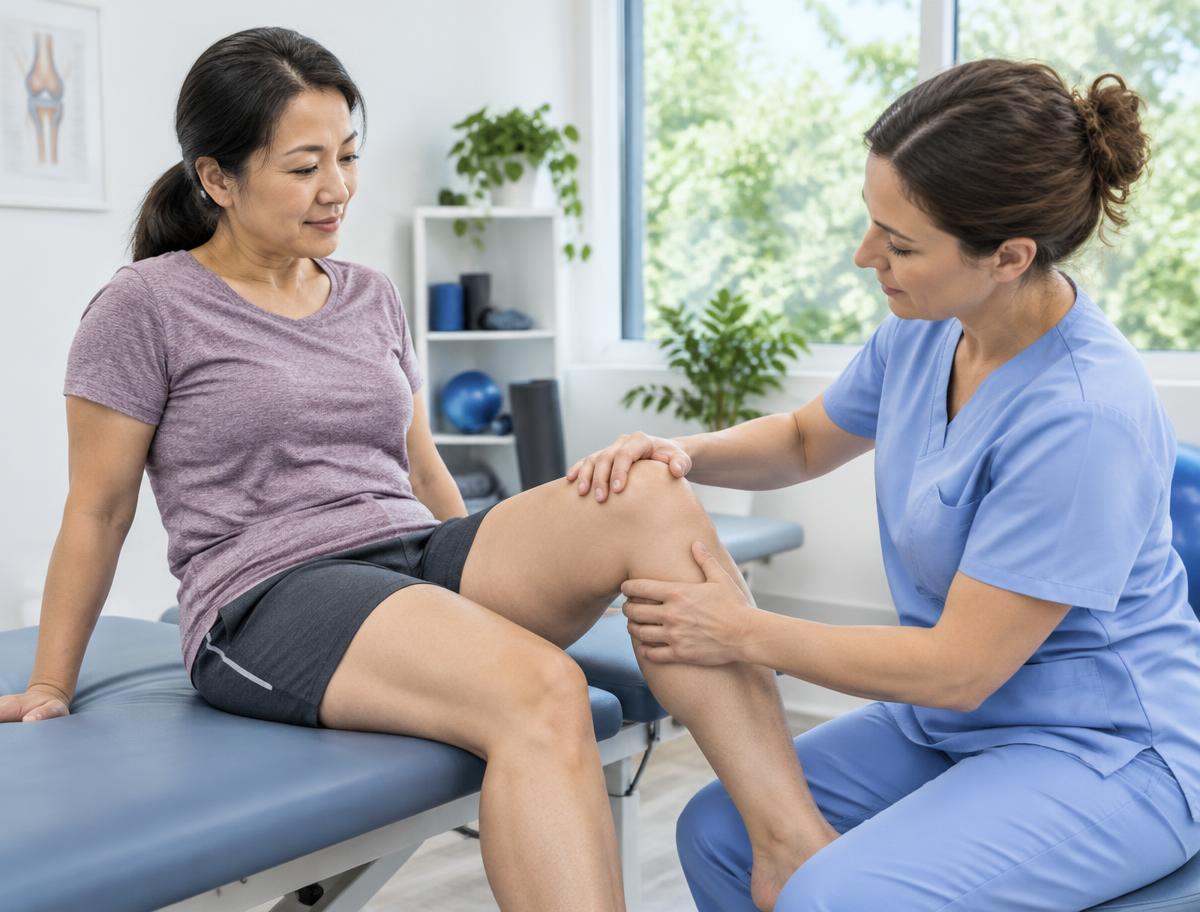
Care depends on the cause. For many non-urgent mechanical problems, an individual plan includes activity adjustment and tailored exercise or physiotherapy. A physiotherapist can help select strengthening and movement work that fits your symptoms and abilities. For osteoarthritis, therapeutic exercise and weight management when appropriate are core recommendations in international guidance, rather than optional extras before a procedure.
A pharmacist or medical team can discuss suitable pain relief and whether a topical anti-inflammatory medicine is appropriate. Medicines have risks and may interact with existing treatment, so do not copy someone else's prescription. Persistent symptoms may lead to discussion of further options, including selected injections or surgery where indicated. There is no single treatment sequence that suits every diagnosis.
Where does stem cell therapy fit?
Stem cell therapy is being investigated for knee conditions, particularly osteoarthritis. Mesenchymal stromal cells are studied partly for the signals they release and their interactions with inflammatory processes. This does not mean an injection is known to rebuild a damaged knee. Products differ in cell source, preparation, dose, and delivery, so findings cannot be freely transferred between approaches.
It is not an established first-line treatment for general knee pain. If you discuss it, ask about the diagnosis, product-specific research, risks, uncertainties, regulatory status, and alternatives. At JointCare Bangkok, information about donated umbilical cord-derived cells and batch checks is available in our stem cell therapy overview. Laboratory quality documentation is important, but it does not prove a clinical outcome.
When to seek help and what to bring
Seek urgent medical assessment for a very painful or badly swollen knee, inability to move it or put weight on it, a changed shape after injury, or a hot red knee with fever or feeling unwell. A knee that locks or repeatedly gives way also needs prompt assessment. Do not wait for a routine enquiry response if these symptoms occur.
For ongoing pain, arrange an assessment if symptoms are not settling or are limiting normal life. A short symptom diary and details of previous treatment make the conversation more useful. Read our consultation guide or ask the medical team a question. This article is general education, not a diagnosis or a recommendation for a particular procedure. The independent sources below do not endorse our clinic.