Guides
Understanding the role of cartilage in movement
Learn what joint cartilage does, how osteoarthritis affects the whole joint, and why assessment matters before choosing care.
Educational content, not individual medical advice.
At a glance
Cartilage helps joint surfaces move smoothly, but joint pain is not a simple measure of cartilage loss. Assessment considers the whole joint, your symptoms, and your daily function.
What is articular cartilage?
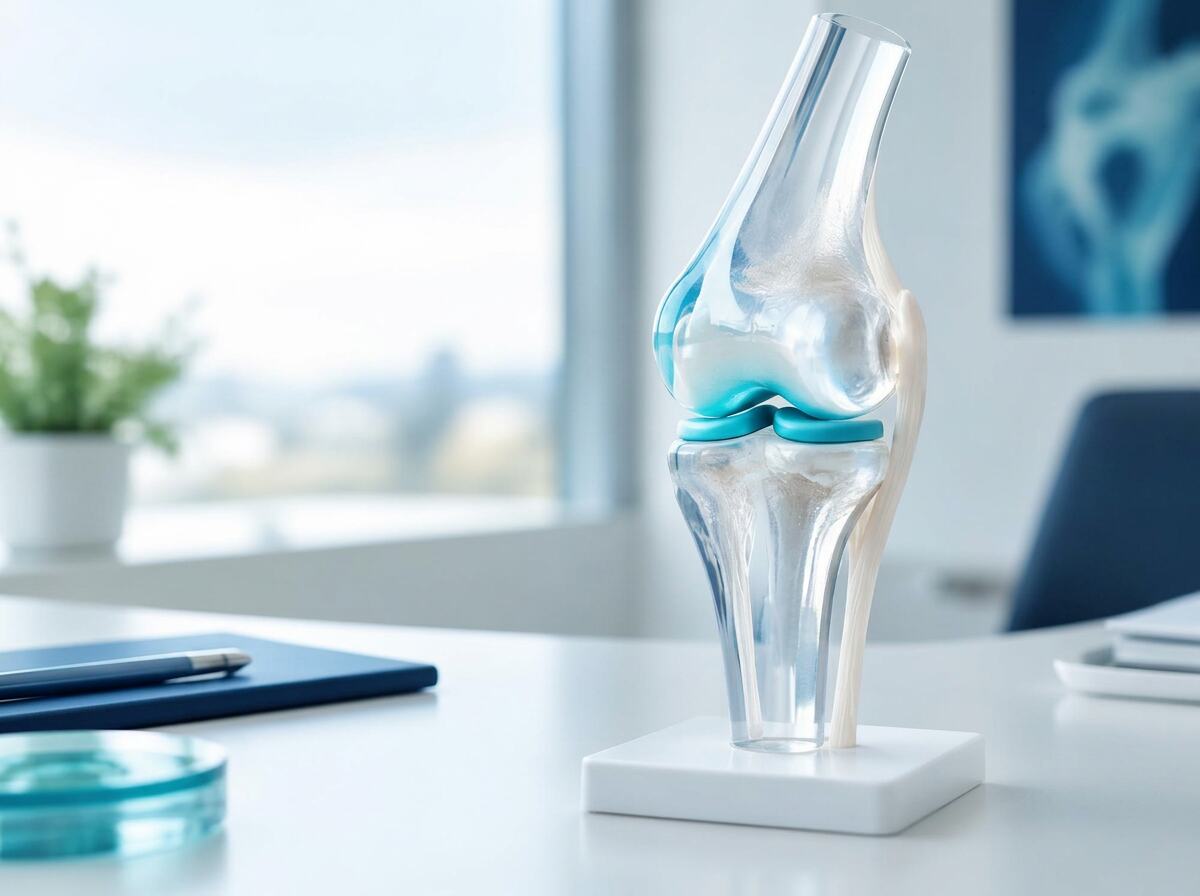
Articular cartilage is the smooth tissue covering the ends of bones in many joints. It helps the surfaces move against each other and contributes to how load is distributed. In everyday movement, cartilage works alongside other structures rather than acting as the joint’s only support. Muscles, ligaments, the joint lining, and the underlying bone all have roles.
It is useful to distinguish articular cartilage from other tissues that may also be called cartilage, such as the meniscus in the knee. An article cannot tell which structure is responsible for your symptoms. If a report uses unfamiliar terms, ask the medical team to explain the location, what the finding means, and whether it is relevant to the difficulty you are experiencing.
Why cartilage has limited repair capacity
Articular cartilage has a limited ability to repair itself, partly because it does not have the same direct blood supply as many other tissues. However, that fact does not tell you how painful a joint will be or determine the right care choice. The size and location of a change, other structures, and the person’s circumstances all matter.
Be cautious about claims that a supplement, injection, or cell product will simply rebuild worn cartilage. A biological explanation is not proof of a clinical outcome. Ask what evidence supports the specific claim, whether it involves people with a similar condition, and how outcomes were measured. Research on tissue biology should not be translated into a promise of regrowth for an individual patient.
How osteoarthritis involves the whole joint
Osteoarthritis is not only a matter of a surface wearing away. It can involve changes in cartilage, bone, and other joint tissues. Symptoms often include pain, stiffness, and difficulty with activities, but experiences vary. Age is one factor, while injury, joint loading, and other circumstances can also play a role.
The phrase “wear and tear” can oversimplify the condition and make people worry that any movement will cause further damage. For osteoarthritis, appropriately tailored exercise is a core part of care in NICE guidance. This does not mean ignoring new symptoms or choosing an exercise plan without context. Ask how the diagnosis fits your symptoms and how activity advice should be adapted to your needs.
Why an image does not tell the whole story
A scan or X ray can provide useful information, but the findings do not capture every aspect of discomfort or function. Some people have visible joint changes with relatively modest symptoms; others have significant difficulties that need a broader explanation. Images should be read alongside the history and examination, not used as a stand alone forecast.
NICE guidance recommends clinical diagnosis of osteoarthritis without routine imaging when typical features are present, unless there are atypical features or another suspected diagnosis. Different situations may need different investigations. Ask whether a proposed test is likely to change management and what it cannot answer. Do not assume an MRI is required simply because you want a clearer explanation.
What care options may be discussed?
The relevant options depend on the condition, symptoms, health factors, and goals. For osteoarthritis, tailored exercise, information, and support are central. Weight management may be discussed where appropriate, and medicines or other interventions may have a role. Surgical assessment may be relevant for some people when symptoms and function warrant it. No single pathway suits everyone.
Ask what each option is intended to do, how it would be monitored, and what its limits are. Advice should be practical rather than implying that all discomfort can be solved by one lifestyle change. The medical team should consider other conditions and medicines before recommending treatment. You can ask for a staged plan and take time to compare appropriate alternatives.
Where stem cell therapy research fits
Studies of cell based approaches to joint conditions use different cell sources, preparation methods, doses, and ways of measuring outcomes. These differences make it important to examine the exact evidence rather than treating all stem cell therapy as one established procedure. A positive result in one study cannot guarantee a result for another product, protocol, or person.
Ask whether a proposed intervention is established care or an investigational approach for your condition, and what local rules apply. The FDA’s consumer information describes important concerns about unapproved regenerative products in the United States; that jurisdiction is not Thailand. Its warnings are useful context, but the clinic should explain the relevant Thai regulatory status separately. No article or consent form should imply guaranteed cartilage restoration.
Questions to take to a joint consultation
Useful questions include: Which structures may explain my symptoms? Does the scan match the examination? Do we need more information? Which care options are relevant? What evidence applies to each one? How will we review function and safety? These questions make the discussion about your situation rather than a general statement about cartilage.
Bring records, a medication list, and examples of affected activities. Explain any injury, swelling, or change in symptoms. JointCare Bangkok offers a free first consultation online or in person; further investigations and treatments should be priced separately. A conversation can help clarify the next step, but this article cannot identify a diagnosis or establish suitability for stem cell therapy.
When should you seek urgent medical help?
Do not wait for a routine joint consultation if a joint becomes hot and swollen and you also feel unwell or have a fever. Sudden severe symptoms, inability to put weight on a joint after an injury, or a new loss of movement need prompt assessment. The appropriate service depends on the situation and your location; use local urgent or emergency care rather than a website enquiry form.
New bladder or bowel changes, numbness around the groin or buttocks, or significant new weakness with back symptoms can require emergency assessment. This is not a complete list of warning signs. If you are unsure how urgent a change is, contact a suitable local medical service. An educational article cannot assess an emergency or tell you that it is safe to wait.
Key points to remember
Use this guide to organise questions, not to select a treatment or diagnose yourself. Your history, examination, health factors, and priorities all contribute to the discussion. Ask for explanations in plain language, compare the relevant alternatives, and request written information about costs, risks, uncertainty, and follow up before making a decision.
The sources below provide background information from public health and clinical guidance organisations. They do not endorse JointCare Bangkok or establish suitability for any clinic procedure. References to guidance from another country should be read in that jurisdiction’s context. The medical team should explain how any proposed care relates to your condition and the rules applicable in Thailand.